

How To Draw Cis 1 3 Dimethylcyclohexane
4.eight: Conformations of Disubstituted Cyclohexanes
- Page ID
- 31415
After completing this section, you lot should be able to utilize conformational analysis to determine the nigh stable conformation of a given disubstituted cyclohexane.
Make certain that you lot can define, and use in context, the key term below.
- conformational analysis
When faced with the problem of trying to decide which of two conformers of a given disubstituted cyclohexane is the more stable, you may find the post-obit generalizations helpful.
- A conformation in which both substituents are equatorial will e'er be more than stable than a conformation with both groups axial.
- When i substituent is axial and the other is equatorial, the most stable conformation will be the 1 with the bulkiest substituent in the equatorial position. Steric bulk decreases in the order
tert-butyl > isopropyl > ethyl > methyl > hydroxyl > halogens
Monosubstituted Cyclohexanes
In the previous section, it was stated that the chair conformation in which the methyl group is equatorial is more than stable because it minimizes steric repulsion, and thus the equilibrium favors the more than stable conformer. This is truthful for all monosubstituted cyclohexanes. The chair conformation which places the substituent in the equatorial position will be the most stable and be favored in the ring flip equilibrium.
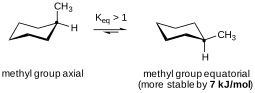

Disubstituted Cyclohexanes
Determining the more stable chair conformation becomes more than complex when at that place are two or more than substituents attached to the cyclohexane ring. To determine the stable chair conformation, the steric effects of each substituent, along with any additional steric interactions, must be taken into account for both chair conformations.
In this section, the consequence of conformations on the relative stability of disubstituted cyclohexanes is examined using the 2 principles:
- Substituents prefer equatorial rather than axial positions in order to minimize the steric strain created of 1,3-diaxial interactions.
- The more stable conformation volition identify the larger substituent in the equatorial position.
1,one-Disubstituted Cyclohexanes
The more stable chair conformation can often exist determined empirically or by using the free energy values of steric interactions previously discussed in this affiliate. Annotation, in some cases there is no discernable energy difference between the two chair conformations which means they are equally stable.
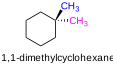
i,i-dimethylcyclohexane does not take cis or trans isomers, considering both methyl groups are on the aforementioned band carbon. Both chair conformers have one methyl group in an axial position and one methyl grouping in an equatorial position giving both the same relative stability. The steric strain created by the 1,3-diaxial interactions of a methyl group in an centric position (versus equatorial) is 7.6 kJ/mol (from Table 4.7.i), so both conformers will have equal amounts of steric strain. Thus, the equilibrium betwixt the two conformers does non favor i or the other. Note, that both methyl groups cannot be equatorial at the same time without breaking bonds and creating a dissimilar molecule.
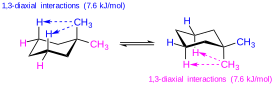
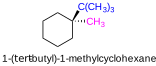
Nonetheless, if the two groups are different, equally in one-tert-butyl-1-methylcyclohexane, then the equilibrium favors the conformer in which the larger group (tert-butyl in this case) is in the more stable equatorial position. The energy cost of having one tert-butyl group axial (versus equatorial) tin exist calculated from the values in table iv.seven.one and is approximately 22.eight kJ/mol. The conformer with the tert-butyl group axial is approximately 15.two kJ/mol (22.8 kJ/mol - 7.half dozen kJ/mol) less stable and so the conformer with the tert-butyl group equatorial. Solving for the equilibrium abiding G shows that the equatorial is preferred most 460:1 over axial. This means that 1-tert-butyl-i-methylcyclohexane will spend the majority of its time in the more stable conformation, with the tert-butyl group in the equatorial position.
-1-methylcyclohexane.svg?revision=1&size=bestfit&width=245&height=101)
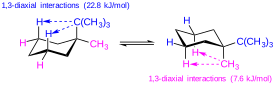-1-methylcyclohexane.svg?revision=1&size=bestfit&width=371&height=112)
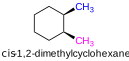
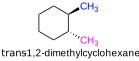
Cis and trans stereoisomers of 1,2-dimethylcyclohexane
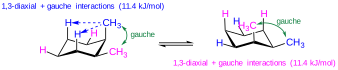
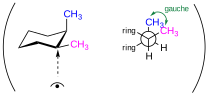
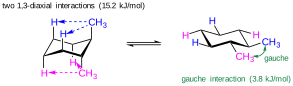
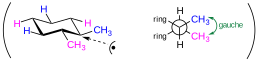
In cis-1,2-dimethylcyclohexane, both chair conformations have one methyl group equatorial and 1 methyl group axial. Equally previously discussed, the centric methyl group creates 7.6 kJ/mol of steric strain due to i,3-diaxial interactions. It is of import to note, that both chair conformations also accept an additional three.8 kJ/mol of steric strain created past a gauche interaction between the two methyl groups. Overall, both chair conformations take 11.4 kJ/mol of steric strain and are of equal stability.
In trans-1,ii-dimethylcyclohexane, one chair conformer has both methyl groups axial and the other conformer has both methyl groups equatorial. The conformer with both methyl groups equatorial has no 1,3-diaxial interactions however there is till iii.eight kJ/mol of strain created by a gauche interaction. The conformer with both methyl groups axial has iv 1,iii-Diaxial interactions which creates two ten 7.6 kJ/mol (fifteen.2 kJ/mol) of steric strain. This conformer is (xv.2 kJ/mol -3.8 kJ/mol) 11.4 kJ/mol less stable than the other conformer. The equilibrium will therefore favor the conformer with both methyl groups in the equatorial position.
Cis and trans stereoisomers of 1,three-dimethylcyclohexane
A similar conformational assay tin can be made for the cis and trans stereoisomers of i,three-dimethylcyclohexane. For cis-one,3-dimethylcyclohexane one chair conformation has both methyl groups in centric positions creating 1,three-diaxial interactions. The other conformer has both methyl groups in equatorial positions thus creating no i,3-diaxial interaction. Because the methyl groups are not on adjacent carbons in the cyclohexane rings gauche interactions are not possible. Even without free energy calculations information technology is simple to determine that the conformer with both methyl groups in the equatorial position volition be the more stable conformer.
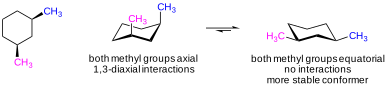
For trans-1,3-dimethylcyclohexane both conformations take one methyl axial and ane methyl group equatorial. Each conformer has i methyl group creating a ane,3-diaxial interaction so both are of equal stability.
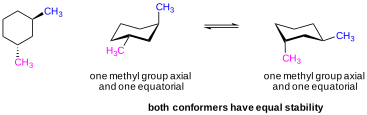
Summary of Disubstitued Cyclohexane Chair Conformations
When considering the conformational analyses discussed to a higher place a pattern begins to form. There are just two possible relationships which tin can occur between ring-flip chair conformations:
1) AA/EE: One chair conformation places both substituents in axial positions creating ane,3-diaxial interactions. The other conformer places both substituents in equatorial positions creating no 1,three-diaxial interactions. This diequatorial conformer is the more stable regardless of the substituents.
2) AE/EA: Each chair conformation places one substituent in the axial position and one substituent in the equatorial position. If the substituents are the aforementioned, at that place will be equal i,3-diaxial interactions in both conformers making them equal in stability. However, if the substituents are different then unlike 1,3-diaxial interactions will occur. The chair conformation which places the larger substituent in the equatorial position will be favored.
| Substitution type | Chair Conformation Human relationship |
| cs-1,2-disubstituted cyclohexanes | AE/EA |
| trans-ane,2-disubstituted cyclohexanes | AA/EE |
| cis-i,iii-disubstituted cyclohexanes | AA/EE |
| trans-1,3-disubstituted cyclohexanes | AE/EA |
| cis-1,iv-disubstituted cyclohexanes | AE/EA |
| trans-1,4-disubstituted cyclohexanes | AA/EE |
For cis-1-chloro-4-methylcyclohexane, depict the most stable chair conformation and make up one's mind the energy difference between the 2 chair conformers.
Solution
Based on the table above, cis-ane,4-disubstitued cyclohexanes should have ii chair conformations each with one substituent centric and one equatorial. Based on this, we tin can surmise that the free energy difference of the two chair conformations volition be based on the divergence in the 1,three-diaxial interactions created past the methyl and chloro substituents.
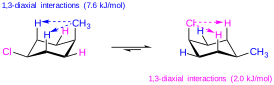
As predicted, each chair conformer places one of the substituents in the centric position. Because the methyl grouping is larger and has a greater 1,3-diaxial interaction than the chloro, the most stable conformer will place it the equatorial position, every bit shown in the structure on the right. Using the 1,3-diaxial energy values given in the previous sections we can calculate that the conformer on the right is (7.6 kJ/mol - 2.0 kJ/mol) v.6 kJ/mol more stable than the other.
For trans-one-chloro-2-methylcyclohexane, draw the nearly stable chair conformation and determine the energy difference between the ii chair conformers.
Solution
Based on the tabular array to a higher place, trans-1,2-disubstitued cyclohexanes should have i chair conformation with both substituents axial and one conformation with both substituents equatorial. Based on this, we can predict that the conformer which places both substituents equatorial volition be the more stable conformer. The energy divergence of the two chair conformations will be based on the i,3-diaxial interactions created past both the methyl and chloro substituents.
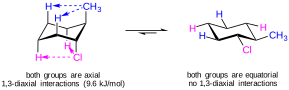
Every bit predicted, 1 chair conformer places both substituents in the axial position and other places both substituents equatorial. The more than stable conformer will place both substituents in the equatorial position, every bit shown in the structure on the right. Using the ane,3-diaxial energy values given in the previous sections we tin can calculate that the conformer on the right is (7.6 kJ/mol + 2.0 kJ/mol) ix.6 kJ/mol more than stable than the other.
Conformational Analysis of Complex Six Membered Ring Structures
Cyclohexane can have more than than ii substituents. Also, in that location are multiple half dozen membered rings which contain atoms other than carbon. All of these systems normally form chair conformations and follow the same steric constraints discussed in this section. Because the most ordinarily found rings in nature are half dozen membered, conformational analysis tin oftentimes help in understanding the usual shapes of some biologically of import molecules. In complex six membered ring structures a direct calculation of 1,three-diaxial energy values may be hard. In these cases a determination of the more than stable chair conformer can exist fabricated by empirically applying the principles of steric interactions.
A later on chapter will discuss how many sugars can exist in cyclic forms which are often six remembered rings. When in an aqueous solution the six carbon sugar, g lucose, is ordinarily a six membered ring adopting a chair conformation. When looking at the ii possible ring-clip chair conformations, one has all of the substituents axial and the other has all the substutents equatorial. Even without a calculation, it is clear that the conformation with all equatorial substituents is the near stable and glucose will most unremarkably exist institute in this conformation.
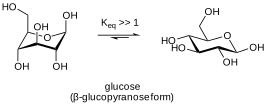
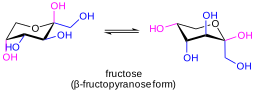
The six carbon sugar, fructose, in aqueous solution is too a six-membered band in a chair conformation. Which of the two possible chair conformations would exist expected to be the most stable?
Solution
The lower energy chair conformation is the i with 3 of the five substituents (including the bulky –CH2OH group) in the equatorial position (pictured on the correct). The left structure has 3 equatorial substituents while the structure on the right only has 2 equatorial substituents.
Exercises
one. Draw the 2 chair conformations for cis-i-ethyl-ii-methylcyclohexane using bond-line structures and betoken the more energetically favored conformation.
2. Draw the most stable conformation for trans-1-ethyl-3-methylcyclohexane using bond-line structures.
three. Depict the most stable conformation for trans-one-t-butyl-4-methylcyclohexane using bond-line structures.
4. Describe the near stable conformation fo trans-one-isopropyl-3-methylcyclohexane.
5. Can a 'band flip' change a cis-disubstituted cyclohexane to trans? Explain.
six. Describe the 2 chair conformations of the six-carbon carbohydrate mannose, existence certain to clearly show each non-hydrogen substituent as centric or equatorial. Predict which conformation is probable to be more than stable, and explain why.

Solutions


4.

The bulkier isopropyl groups is in the equatorial position.
5. No. In order to change the relationship of 2 substituents on a ring from cis to trans, you would need to break and reform two covalent bonds. Ring flips involve only rotation of single bonds.
half-dozen.

Exercises
Questions
Q4.8.one
For the following molecules draw the most stable chair conformation and explicate why you chose this equally an respond
1 = trans-ane,2-dimethylcyclohexane
2 = cis-ane,three-dimethylcyclohexane
Solutions
S4.viii.1
1 – The most stable conformation would exist to accept the methyl groups equatorial reducing steric interaction
2 – The most stable conformation would exist to have the groups equatorial this would reduce the strain if they were axial


Source: https://chem.libretexts.org/Bookshelves/Organic_Chemistry/Organic_Chemistry_(McMurry)/04%3A_Organic_Compounds-_Cycloalkanes_and_their_Stereochemistry/4.08%3A_Conformations_of_Disubstituted_Cyclohexanes
Posted by: alleynejustoll.blogspot.com
0 Response to "How To Draw Cis 1 3 Dimethylcyclohexane"
Post a Comment